Monday, August 3, 2009

10th Post

States of matter

Apparently,atoms,molecules,and ions have distinct forms when conditions change(such as temperature),which we will talk about as we show a picture-
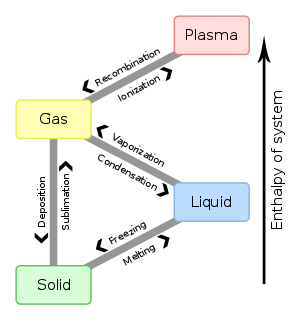


We will only be touching on Solids,Liquids,and Gases.

Solid
The particles (ions, atoms or molecules) are packed closely together, so closely that the particles cannot move freely but can only vibrate. As a result, a solid has a stable, definite shape, and a definite volume. Solids can only change their shape by force, as when broken or cut.Thus,they cannot be compressed.

TRANSITION:
Watch the ice melt!


Liquid
Now that our ice is now water,lets continue...
The volume is definite if the temperature and pressure are constant. When a solid is heated above its melting point, it becomes liquid. There is still some force between the particles,but the molecules are now more spread out and have more 'freedom' with a mobile structure. This means that the shape of a liquid is not definite but is determined by its container. The volume is usually greater than that of the corresponding solid, with the noteworthy exception of water, H2O.

TRANSITION:
Watch the water turn into gas within seconds!(Okay,you don't normally see this)


Gas
Now that our water is in a gaseous state,lets continue...
The molecules have enough kinetic energy so that the effect of forces between the molecules are small, and the molecules are far apart from each other. A gas has no definite shape or volume, but occupies the entire container in which it is confined. A liquid may be converted to a gas by heating at constant pressure to the boiling point, or else by reducing the pressure at constant temperature.

Links:
http://en.wikipedia.org/wiki/State_of_matter
http://www.youtube.com/watch?v=K-GSrrk_ATM
http://www.youtube.com/watch?v=04gnMELg-7Y

9th Post

Now that we have handled what atoms,molecules,and ions are,we can talk about the things they are related to.

Such as diffusion.

Fact 1:Atoms,Molecules,Ions all 'vibrate' and move in a constant and random motion unless their temperature is exactly zero.This is called absolute zero and it's 0 K on the Kelvin scale, −273.15° on the Celcius scale or −459.67° on the Fahrenheit scale.We are unable to observe it,however,as in order to observe it,we require light,and shining light on that atom/molecule/ion will give them heat,and it won't be absolute zero if it has heat,yeah?

Now although it is in a random motion,the particles have a tendency of spreading from a region where they are more concentrated to a region where they are less concentrated,and this goes on until both sides have equal concentration.

It doesn't mean that they don't move in a constant and random motion after they are happy with their places,however.

This spreading of particles from a higher concentration to a lower concentration is called 'Diffusion'.


Osmosis is somewhat like diffusion,but
1.It only involves water molecules
2.It requires a semi-permeable membrane(and only water molecules can pass through)

It is from high concentration to low concentration again,but this time it is the concentration of water molecules.

As diffusion is very alike osmosis in a sense,I'll just let the videos take over the action.

Besides,pictures speak louder than words.

What is Osmosis


LIVE example of Osmosis


Links:
http://www.youtube.com/watch?v=gXJMBgyT_hk
http://www.youtube.com/watch?v=xR9EQNJGBrE&feature=related
http://www.youtube.com/watch?v=7WX8zz_RlnE&feature=fvw
http://www.youtube.com/results?search_query=diffusion&search_type=&aq=f

8th Post

What are Ions?

An ion is an atom or molecule where the total number of electrons(which are negative) is not equal to the total number of protons(which are positive),making it either positive or negative electrical charge on the whole.

Thus,if the number of electrons is greater than the number of protons,it would result in the atom/molecule having a negative charge.This kind of ion is called 'anion'(Onions are great,but this 'anion' isn't for eating),which means up in Greek.

On the other hand,if the number of protons is greater than the number of electrons,it would result in the atom/molecule having a positive charge.This kind of ion is called 'cation',which means down in Greek.

An ion consisting of a single atom is called a monatomic ion.

If it consists of two or more atoms(molecules), it is called a polyatomic ion.

Polyatomic ions containing oxygen, such as carbonate and sulfate, are called oxyanions.(I can't help but think that the guy behind all these love onions)

Ions are essential to life,playing an important role in the cells of living organisms, particularly in cell membranes. They have many practical, everyday applications in items such as smoke detectors, and are also finding use in unconventional technologies such as ion engines.

Links:
http://en.wikipedia.org/wiki/Ion#Ionic_bonding

Sunday, August 2, 2009

Post 7

What are

Molecules?

Well,remembering we brought up Lego in our last post,molecules are basically 2 atoms or more held together with very strong chemical bonds.If you find this hard to imagine,just imagine 2 lego pieces stuck together.

Very tightly.

They are still extremely small though,and most of them cannot be seen with the naked eye,except for macromolecules,(large molecules).

A molecule may consist of atoms of a single chemical element(a pure chemical substance consisting of only one type of atom),or of different elements(molecules can also consist of very little atoms or a lot of atoms).

Although the bonding of atoms can be very strong,there are also different types of bonds and the strengths of bonds do vary.

I'll just give an example on the covalent bond,one of the various ways of bonding.

The simplest way of the covalent bond is when one or more electrons are drawn into the space between the two atomic nuclei. Here the negatively charged electrons are attracted to the positive charges of both nuclei, instead of just their own(negative is attracted to positive).This overcomes the repulsion between the two positively charged nuclei of the two atoms(positive repels positive like negative will repel negative), and so this overwhelming attraction holds the two nuclei in a fixed position(although they will still vibrate due to diffusion).

A very basic recap on what we have talked about:


Links:
http://en.wikipedia.org/wiki/Molecule
http://en.wikipedia.org/wiki/Chemical_bond
http://www.youtube.com/watch?v=SVyEpeniCzQ&feature=related