Friday, July 31, 2009

6th Post

Now onwards to chemistry!

Well,I have chosen to research on Atoms,Molecules,and Ions.

Well,we'll enter it in a step by step approach like we did for biology.

FIRST OF ALL

What
Is
Atoms?

As atoms are really complex,explaining it in the way wikipedia does is not going to get through to somebody who has no idea what an atom is.

So,lets begin with something simple.

I suppose you all have played with Lego bricks,have you?'

They look like this:


Well,using these lego bricks,you create something-A car,a robot,a monster,a man,or your dream house.

Or maybe build a scene where your worst enemy falls off the cliff and into a pile of manure.

Whatever.

Well,using these bricks,you create something.


Now lets take a moment or two to enjoy the scenery.......

Right.

Now you are probably asking:'Why in the world are you talking about lego when you are suposed to be talking about atoms?What are you?a 2 year old?*Rant Rave blah blah blah etc etc grrr........'

The reason why i touched on lego is because Atoms,are like lego bricks.They are the building blocks of the world,and everything and including us is made out of atoms.

Now like your lego blocks are made out of plastic,Atoms are also consists of some things that form an atom.And these are:

Protons
Positive charge,these are found in the nucleus.

Neutrons
No charge(Neutral)

Electrons
Negative charge,these circle around the nucleus.

The electrons take a 'pathway' when they circle the nucleus,and that is the electron shell.Each shell can contain only a fixed number of electrons.
Nucleus
Protons are Neutrons join together to form this buddy,the central part of the atom.Over 99.9% of an atom's mass is concentrated here.


Not surprisingly,the plastic that make the lego bricks are made out of something as well.

Protons and Neutrons have 3 quarks(It is not made with any smaller particles,it is an elementary particle.)each.

More on quarks


The electron is,however,a point particle(it does not take up space,and it is not made with any smaller particles).

Atoms always have the same number of electrons as protons.

Overview of what atoms are.It covers some extra information that is not stated in the words above.


Links:
http://www.chem4kids.com/files/atom_structure.html
http://education.jlab.org/atomtour/index.html
http://en.wikipedia.org/wiki/Atom#Magnetic_moment
http://www.youtube.com/watch?v=TGrDj5vFefQ&feature=related
http://www.youtube.com/watch?v=zl1lG9JNr6M&feature=fvw
http://www.youtube.com/results?search_query=atoms&search_type=&aq=f

Tuesday, July 14, 2009

Entry 5

The Large Intestine

This is the last part of the digestive system.

Its function is to absorb water from the remaining indigestible food matter, and then to pass out useless waste materials from the body through the anus(and into the toilet,or your worst enemy's living room,whichever you prefer).

The large intestine is about 1.5 metres (4.9 ft) long.

he large intestine takes 32 hours to finish up the remaining processes of the digestive system. Food is not broken down any further in this stage of digestion. The large intestine simply absorbs vitamins that are created by the bacteria inhabiting the colon. It also absorbs water and compacts feces, and stores fecal matter in the rectum until eliminated through the anus and this is responsible for passing along solid waste.

The large intestine houses over 700 species of bacteria that perform a variety of functions,and these bacteria produce large amounts of vitamin for absorption into the blood.Of course,due to such a large amount of bacteria in the large intestine,it has a wall of mucus to protect it from attacks from bacteria.

...Your apple pie doesn't look so appetizing anymore,now does it?

And that is all for the human digestive system!

OVERVIEW:

A quick one:


A serious,detailed,but perhaps boring one(Looks familiar to you?):


This one has a funny side:

http://www.youtube.com/watch?v=F7imREJnV30&feature=related


Q & A TIME!!!

Q:Can you actually EAT upside-down?


Can you,really,with the force of gravity working on you?Lets find out...

A: Yes, you can swallow upside down because the muscles around the esophagus are strong enough to push the food up to your stomach.Of course,it is definitely not recommended to try.


Q:Is holding your faeces good for your health?

...

A:Yes.It is.

No.I'm just kidding.

Faeces pass through the colon and wait inside of the rectum, triggering nerve endings to tell you that you need to use the bathroom. If you resist the urge for longer than 30 seconds, the feces goes back up into the colon, where the colon absorbs water from the stool and tries to pass it down to the rectum again. Besides absorbing all the bacterial waste, this obviously dries things out and if you wait too long it can give you extreme constipation.

Ow.


Q:Why does your faeces stink?

Hmm,good question...

A:The faeces that you excrete through your anus from the rectum may give of a bad smell due to the unwanted nutrients that are within the faeces. Unwanted products such as plant fibres is what makes the smell.

Another reason is it is the result of the products of bacterial action. Bacteria produce smelly, sulfur-rich organic compounds. These are the same compounds that give farts their odor.

Q:Why do you vomit?


A:For adults, vomiting is commonly a result of a viral infection and food poisoning, and occasionally a result of motion sickness and illnesses in which the person has a high fever. An amazing variety of stimuli can trigger vomiting.

Fortunately,sometimes just seeing someone else vomit will start you vomiting, in your body's effort to protect you from possible exposure to the same danger.

For kids,it is common for vomiting to occur from a viral infection, food poisoning, motion sickness, overeating or feeding, coughing, and illnesses in which the child has a high fever.For toddlers and babies,vomit occurs due to infections in the body.

Even anxiety can cause you to worry!

Links:
http://en.wikipedia.org/wiki/Large_intestine

Monday, July 13, 2009

4th Post


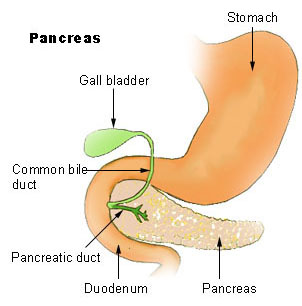
The Pancreas is a yellowish organ in us,and lies below the stomach.It is connected to the duodenum(as you can see).

Its main job in the digestive system is to create enzymes to digest food and break down starch,proteins,and fats which are mixed with chyme(...Remember that apple pie?Chyme is partially undigested food) .It creates a mixture called 'Pancreatic Juice',(alkaline),which contains amylase(break down starch),lipase(break down fats) and trypsin(break down proteins),and water.

Video:


Word for word,hmm?:P

Well,back to the Duodenum,and the small intestines.

The Duodenum


The duodenum is the first section of the 'Jejunum',which is in other words the small intestines.

Though the duodenum is such a tiny fraction of the small intestine, it is the site of most of the breakdown of the food passing through it(Therefore why there is such a special place for it). The duodenum is lined with Brunner's glands, which secrete an alkaline mucus that support the intestinal enzymes and aids in the absorption of nutrients. The pancreatic duct, which introduces bile and pancreatic juice into the small intestine, is directly connected to the descending duodenum.Pancreatic juice contains enzymes that help break down food, while bile aids in the digestion and absorption of fats. The duodenum is responsible for secreting hormones that trigger the pancreatic duct to release pancreatic juice and bile.

As the chyme went through the stomach which has a very high acid level,both the Brunner's glands and the pancreatic duct secrete alkaline fluids to temper the acidity of the chyme. In addition, the mucus secreted by the Brunner's glands helps protect the duodenum from the acidity, making the duodenum much less sensitive than the rest of the small intestine to the acidic chyme. Therefore, the duodenum helps protect the rest of the small intestine by neutralizing the chyme to some extent before it passes into the jejunum(the small intestines are not protected by mucus).This is probably the reason why the pancreatic juice from the pancreas is alkaline instead of acid.

The Jejunum

Now I know you are VERY VERY BORED from all that text and stuff,so heres a little treat for you!


Links:
http://en.wikipedia.org/wiki/Pancreas
http://www.mamashealth.com/organs/pancreas.asp
http://en.wikipedia.org/wiki/Duodenum
http://en.wikipedia.org/wiki/Jejunum
http://www.youtube.com/watch?v=j5WF8wUFNkI&eurl=http%3A%2F%2Fbiochembloggie.blogspot.com%2F&feature=player_embedded
http://www.youtube.com/watch?v=xu5jDCX2cHM&eurl=http%3A%2F%2Fbiochembloggie.blogspot.com%2F&feature=player_embedded
http://upload.wikimedia.org/wikipedia/commons/thumb/3/3d/Illu_small_intestine.jpg/250px-Illu_small_intestine.jpg
http://upload.wikimedia.org/wikipedia/commons/6/64/Illu_pancrease.jpg

Monday, July 6, 2009

3rd Entry

The Stomach

The stomach lies between the Esophagus(which was explained in the 2nd Entry)and the duodenum(The first part of the small intestines).


Well,lets have a little recap...

Scene 1:Your mouth makes mincemeat out of some apple pie you decided to eat.Yum Yum.

Scene 2:You swallow the apple pie,and it passes through the Esophagus(OR Oesophagus.They are both the same thing) by Peristalsis.

Scene 3: ...........

The stomach generates strong acids and enzymes to help in digestion(This mixture of acids and enzymes is called gastric juice),and the inner lining of it has several mechanisms to resist the effect of gastric juice on itself, but the esophagus does not.

This means that the gastric juice from the stomach can always go up into the Esophagus and we would have a very serious gullet problem in our hands daily.

Thanks to the Lower Esophageal Sphincter(Cardia,or just Esophagus Sphincter),it helps prevent that from happening(:o you won't stare at those Super Mario games and wished you could jump like that,thank gosh).Of course,for some people who tend to eat supper daily,when they are old due to the digestive system used to eating extra food,the stomach creates more gastric acid.And that results in heartburn.

Owch.

The esophagus is protected from these acids by a one-way valve mechanism at its junction with the stomach. This one-way valve is called the esophageal sphincter (as introduced above), and prevents gastric juice from flowing back into the esophagus.

Or your apple bits from going up the esophagus.

Or last night's chicken scraps.

Whatever.

So your apple bits pass through the esophagus,go right past the esophageal sphincter,and into the stomach,with no way to go back.Looks like it's 'Game Over' for our apple bits.

In humans, the stomach has a relaxed, empty volume of about 45 ml. It generally expands to hold about 1 litre of food, but can hold as much as 1.5 liters.

The stomach is like a bag of muscles,with gastric juice inside to aid the digestion.

The stomach is lined with mucus to protect it from the stomach acid,so you don't get digested by your own stomach.Of course,that is possible,but only occurs when you do not eat regularly or for a long period of time.

Now in order to prevent the 'Once-was-your-happy-apple-pie' stuff to just pass through the stomach and into the duodenum(and then into the small intestines),the stomach's acids need time to actually dissolve the apple bits.Just a 10 second whoosh through the stomach like you're in a theme park would not do much help.

When the food is still in the stomach,the Protease enzymes are secreted into the stomach and and digest the proteins.

Thus,the Pyloric sphincter (or Pylorus) is there,working with the Esophageal sphincter,to 'lock up' the stomach for a good few hours so that the food would be rather dissolved.

Pylorus,in greek,is 'Gate guard'.Now we know where that name came from.

The pylorus is connected to the duodenum,and is divided into 2 parts:

The pyloric antrum, which connects to the body of the stomach.
The pyloric canal, which connects to the duodenum.

The pyloric sphincter, or valve, is a strong ring of smooth muscle at the end of the pyloric canal and lets food pass from the stomach to the duodenum.

Bored to TEARS with this boring chunk of english text?Lets watch a video!


Woah!Lets take a break from the stomach adventure and to something new.

The Gallbladder

This buddy stores about 50 mL of bile(created by the liver),which is released when food containing fat enters the digestive tract(The digestive system).

After being stored in the gallbladder, the bile becomes more concentrated than when it left the liver, increasing its potency and intensifying its effect on fats.

Most digestion occurs in the heat.

The human gallbladder is shaped like a pear, although the organ's shape and function vary considerably among other mammalian species.


Links:
http://en.wikipedia.org/wiki/Stomach
http://en.wikipedia.org/wiki/Cardia#Function
http://www.healthline.com/blogs/exercise_fitness/uploaded_images/VikkiHamTreeStretch-708771.jpg
http://en.wikipedia.org/wiki/Pylorus
http://en.wikipedia.org/wiki/Duodenum
http://en.wikipedia.org/wiki/Gallbladder
http://www.youtube.com/watch?v=qTEun6mHmzA&eurl=http%3A%2F%2Fbiochembloggie.blogspot.com%2F&feature=player_embedded

Sunday, July 5, 2009

2nd Entry

After the mouth has done its job by chewing the food into much smaller pieces,and when the food it swallowed it is passed through...

The throat!

Heres a short video on it before we move on


Here's your ''Subtitles''

The throat is the pathway linking the mouth, nose, esophagus and trachea. When food is swallowed the soft palate closes off the postnasal cavity to prevent food from entering. At the same time a flap of elastic cartilage, the epiglottis, temporarily closes off the trachea to prevent food and liquid from entering.

Lets continue.

The Esophagus (gullet)

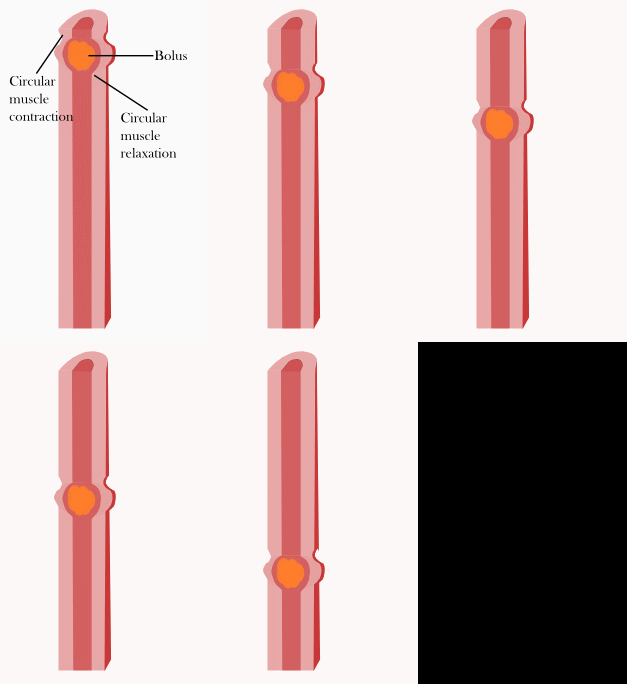
by a process called peristalsis,which is the contraction of smooth muscles to propel something(your food)through the digestive system.

In other words...

Scene 1:Your delicious apple pie(presuming you like apple pie) has been chewed up to bits and is now about to pass through the Esophagus.

Even if you didn't like/eat apple pie,you can always replace it with something else...Like Roti Prata...Or Fish and Chips...

Ahem!!

Scene 2:As the bits of apple(or pie,whatever,lol) slide down the Esophagus,the circular smooth muscles behind the bits of apple contracts,while the muscles in front of the apple bits relaxes,Which pushes the apple bits forward.

In a picture....
From Wikipedia.

Hmm,that looks more like some squished orange than apple bits.

Ahem..!

Bolus: A soft mass of chewed food within the mouth or alimentary canal.

The Liver

The liver has lots of functions.Here are a very few of them:
1.Fighting Infections

2.Creating bile

3.Store vitamins and minerals

4.Making enzymes and proteins that are responsible for most of the chemical reactions in the body.

5.Breaking down food into energy

As the liver is a very complex organ,this is just a very basic summary of the digestive functions of it.

Your liver plays a vital role in fighting infections,particularly infections arising in the bowel by mobilizing part of your body's defense mechanism called the macrophage system.The liver contains over half of the body's supply of these macrophages.

Macrophages: White blood cells within tissues,produced by Monocytes.their role is to engulf and then digest cellular debris, and pathogen either as stationary or mobile cells, and to stimulate lymphocytes and other immune cells to respond to the pathogen.

Pathogen:A germ that causes diseases or illness.

Lymphocytes:A type of white blood cell in the immune system.

Monocytes: A type of white blood cell,part of the human body's immune system.

In digestion its primary purpose is to provide bile, which is stored in the gallbladder, and released into the intestines when eating to help break down fat physically by breaking the large droplets of fat into smaller droplets. This aids in the function of the enzyme lipase, which is what actually digests the fat. The bile is actually a by-product of the filtering action of the liver(the liver is also 'in-charge' of clearing out the blood of particles and infections including bacteria).


Links:
http://en.wikipedia.org/wiki/Esophagus
http://upload.wikimedia.org/wikipedia/commons/0/0f/Peristalsis.gif
http://en.wikipedia.org/wiki/Peristalsis
http://www.thefreedictionary.com/bolus
http://wiki.answers.com/Q/What_functions_does_the_liver_have_in_your_digestion
http://www.britishlivertrust.org.uk/home/the-liver/summary-of-the-livers-functions.aspx
http://www.mamashealth.com/organs/liver.asp
http://en.wikipedia.org/wiki/Liver#Blood_flow
http://en.wikipedia.org/wiki/Macrophage
http://www.youtube.com/watch?v=CigUyfSv3w0&eurl=http%3A%2F%2Fbiochembloggie.blogspot.com%2F&feature=player_embedded